
Josep Caules: “Our cuisine begins at sea: we want to know where every product comes from and how it reaches the plate”
 Foodies on Menorca
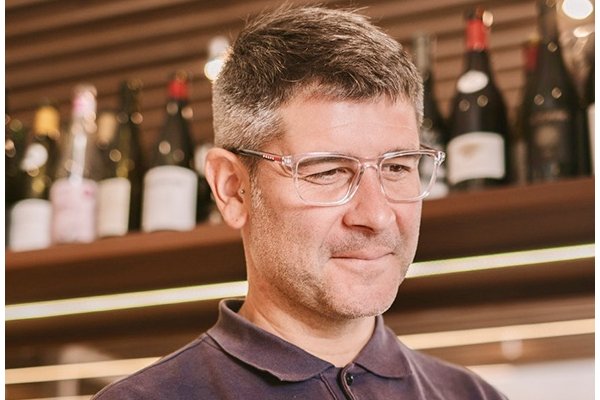
Itziar Lecea/Ciutadella - Owning your own trawler is not a common decision in the restaurant world, but at Café Balear this commitment has been shaping the course of the business for years and defines much of its gastronomic philosophy. Josep Caules Arguimbau, the restaurant’s current manager, explains how direct management of the fishing operation affects the day-to-day running of the business, what the main challenges facing Menorca’s fishing sector are, and how the need to preserve the sea coexists —not always easily— with the economic reality of a company that provides jobs both on land and on board.
It is an insider’s view of a distinctive model based on knowledge of the product, proximity and control of the entire process, from the catch until the fish reaches the plate. A way of working deeply rooted in the territory, but also subject to the difficulties, contradictions and uncertainties that currently affect professional fishing.
Café Balear is a unique case within Menorcan restaurants because of its direct connection with fishing. How and why did you decide to have your own boat?
It all comes from a very clear obsession with the product. With the trawler we have —the Rosa Santa Primera, which we went to collect in Cambrils— we first went to see it, made sure we liked it and then adapted it slightly to our needs. We changed the doors, the winch and other elements to make it suitable for the waters here. The idea has always been to have as few intermediaries as possible. To know exactly when the fish was caught, how we handle it, how we preserve it, how we keep it until it reaches the restaurant and, finally, how we serve it to the customer. Being able to have a product that has just come out of the sea was something we dreamed of and managed to make a reality. And it all starts there: with an obsession with the product. That is the way of working we have maintained to this day, although the road has not been easy at all.
When you say the road has not been easy, what exactly do you mean?
We have never had a smooth path. It is becoming increasingly complicated, and not necessarily because there is no product. The main problem is all the administrative and legislative obstacles. We understand many of these regulations and, to a large extent, we agree with them, because they have a clear objective: to preserve resources and ensure that there will still be fishing many years from now. But it is also true that there is a constant duality. What helps you in the long term can harm you enormously in the short term. There are decisions that make sense on paper but are then very difficult to manage in day-to-day reality. And on top of all that, there is the weather: there are seasons, weeks or even entire months that work against you, while others work in your favour.
Does this close relationship with the sea come from your family?
Yes, there is a very clear family connection. We are not fishermen in the traditional sense of the word, but we do own a fishing boat and, at the same time, run a restaurant business. We manage a fishing company with a crew and sailors, and that forces you to remain in constant contact with the sector. Even though we are not the ones who technically carry out the fishing ourselves, you need to know a little about everything: regulations, biology, seasons and the market. In the end, if you are going to sell that product in the restaurant and you do not know it in depth, you are in trouble.
From a gastronomic point of view, what does having your own fishing boat bring to the restaurant?
It gives us a certain degree of freedom. We can decide what we want to fish for depending on the moment. If today we are more interested in having John Dory, monkfish, scorpionfish or whatever it may be, we can try, always taking into account all the limitations, closed seasons and restrictions imposed on us. Obviously, not everything depends on what we want.
We also buy from small-scale fishermen, both to have greater variety and to offer products that we cannot catch ourselves. The aim is to cover as much as possible with fish from here, but we also have to be realistic: nowadays, with the transport links available, sometimes a product arrives from elsewhere —from Asturias, for example— and it is extremely fresh. And we should not be ashamed to say so.
Owning a boat also involves obvious risks. What happens when the weather is bad and you cannot go out fishing?
That is a major handicap. If you cannot go out, you do not have product, and if you do not have product, you have to buy it. Everyone does that. The restaurant still has to open. That is where balance comes in: managing what you have, what you can offer, portion sizes and customers’ expectations. It is not always easy to explain that a certain fish is not available today because the sea did not allow it. But that is part of the game.
In recent years, how have you seen the fishing sector evolve, especially with the introduction of increasingly strict European regulations?
What we are seeing is that it is becoming increasingly difficult to carry out almost any kind of action. And that does not mean we want carte blanche or to do whatever we feel like. We have always supported biological rest periods, respecting reproduction and the rhythms of the sea. But it is also true that human beings are gatherers; we need to feed ourselves. Sometimes something as basic as travelling somewhere to repair the boat becomes an odyssey. The Balearic Islands have a strong fishing tradition, yet paradoxically there is a very limited range of services available to professional fishing. That makes day-to-day operations extremely difficult.
Have you noticed changes in catches over the years?
There are many factors involved. Political decisions, technical requirements, camera monitoring systems, technology… All of this affects the final result. But then there are things you cannot control: water temperature, currents, fish behaviour. Not everything is as mathematical as it sometimes appears from behind a desk. Some years are better and some are worse, and it is not always directly related to regulation.
Do you think this model —combining fishing and restaurant activity within the same company— is sustainable in the long term?
Honestly, I do not know. Every year we do more calculations, more figures, trying to make everything balance down to the smallest detail. But this is not just a company that has to generate economic profit. There is also a very strong emotional side to it. There are people working on board, there are employees in the restaurant, there are families who depend on all this. Decisions are made at the beginning of the year, but afterwards many things can change.
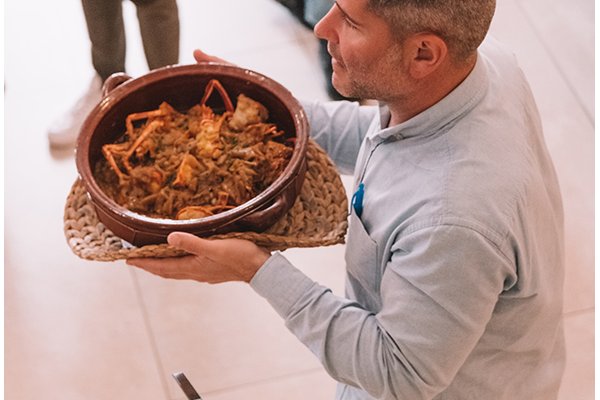
Sometimes you have already planned to stop, carry out maintenance or give people holidays, and suddenly the calendar changes and it affects a key period such as Christmas, which is a very important time for the sale of certain products, such as prawns. Everything is a very delicate mechanism, and any change has knock-on effects throughout the whole operation.
What is the most difficult thing to manage within this whole system today?
Uncertainty. Not knowing exactly what you are going to be facing six months from now. We try to maintain a certain degree of stability for the workers, a kind of steady arrangement so they can work as many days as possible. But we depend on many variables that we cannot control: regulations, the market and the weather. It is complicated, very complicated, but for now we carry on because we believe in this way of working.



Latest posts
-
 Read more
Lluís Febrer: “We make pastries for everyone; they just happen to be suitable for people with coeliac disease too”
Read more14/10/2026Foodies on Menorca
-
 Read more
Luís Galán, of L’Àncora, Special Jury Award at the Foodies on Menorca Awards: “You have to be a fighter and honest; if you are a fighter and honest, everything goes your way”
Read more07/10/2026Foodies on Menorca
-
 Read more
Paco Domínguez of Mr. Bep’s, Foodies on Menorca Lifetime Achievement Award: “We anticipated the change in tourism and chose to focus on quality”
Read more02/10/2026Foodies on Menorca
-
 Read more
Tonia Pons Prats: “If we lose Ciutadella’s Market Square, we will also lose a way of buying and eating fish”
Read more09/07/2026Foodies on Menorca
- Publicitat

-
Publicitat



Sitemap
Cookies policy
Cookie settings
Legal notice
Privacy policy
 © Copyright 2018 - 2026