
The “porquejades” (pig slaughtering in Menorca)
 Foodies on Menorca
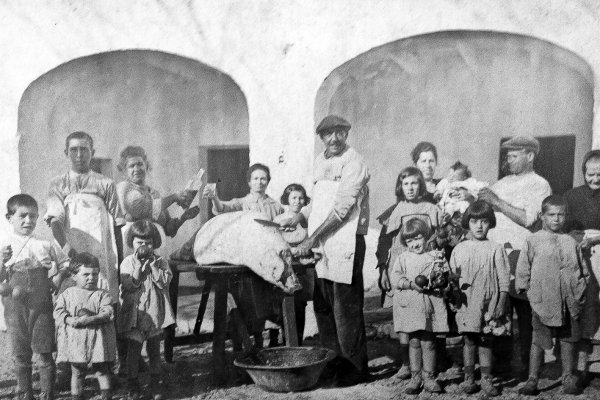
We reproduce the section devoted to “The porquejades” from the unpublished History of Ciutadella by Josep Cavaller Piris, from the chapter dedicated to the old customs of our town.
Many citizens of Ciutadella who are fortunate enough to live in the town itself remember with pleasure and eager anticipation the recurring celebration of the customary porquejades; and for those who, for various reasons, have been forced to leave Ciutadella, the celebration of this deeply endearing and eminently family occasion holds no small place among the nostalgia for the place where they were born.
Even more than the cold that heralds winter’s arrival, it is the cheerful songs—heard through our streets—of boys and girls, some in white aprons and others with aprons and sleevelets of the same color, who, accompanied by the lively click of castanets, break the stillness of our town with the typical songs:
Falderet on the outside,
Falderet on the inside.
The more it sinks,
the more it goes in.
It is true that, for reasons of hygiene and public health, nowadays pigs are no longer fattened in people’s homes, nor is it allowed—as in past times—to slaughter them in the middle of the street, in front of the houses where the celebration took place.
In our day these animals are raised in public pens or in orchards and vegetable plots belonging to modest families; and the slaughter is carried out in those same places or in the courtyard of the houses themselves.
Very early in the morning the little ones get out of bed to watch the fire being lit under the cauldron and, delighted, they listen to the conversations and observe the preparations of the slaughterer and those who will help him with the work that is about to begin. The conversations are extremely varied and follow the rhythm of cigarette smoke or the pipe filled with “pota” tobacco, and between sip and sip of coffee, along with the occasional little glass of gin or anise.
The trough, table—or rather, the box suitable for the slaughter and cleaning of the hog—is already prepared, as are the rough stones and the knives needed for the work. The woman in charge of stirring the blood has all the utensils clean and the basin ready for use.
The moment has arrived, and the pig’s screams as it lies on the trough announce that the knife has begun its work and that it is useless for the animal to try to free itself from the many hands holding its limbs—even its tail, firmly gripped by the innocent hands of the youngest in the house, who tries to pull it off so he can later fasten it onto one of those present.
Mestre Toni has struck true! It no longer moves or throbs.
Nor does it even flinch at the boiling water poured over its body...
Now the rough stones pass over that lifeless body, watched by young and old alike. The ugly blackness that previously covered the pig’s hide gives way to white as the boiling water makes it easier for the volcanic stones to do the work of scraping it clean.
Apron behind,
apron in front;
our little pig
has been bled.
We’re at the porquejades
and they didn’t invite me;
our little pig
they’ve gone and killed.
On the clean table lies the little pig, no less clean now, awaiting decapitation and the cutting off of its limbs, as well as the general butchering.
The slaughterers’ aprons begin to lose their whiteness and the women bustle back and forth preparing the children’s meal, and soon the “buganters” will be called for.
A masterful cut from head to tail has laid bare the animal’s belly, which guests and onlookers contemplate in this first act of the porquejades; the belly and loin, heralds of the good care and profit the owner has managed to get from that animal, which will soon be turned into excellent sobrasada, tasty cuixot, tempting butifarra, and hearty botifarró.
Little glasses of gin and the well-known anise begin to warm the palates of those gathered, while some women and the children wait for the knife to continue its uninterrupted work and expose the animal’s intestines, which must undergo the indispensable washing in the waters of our harbor.
At the new quay? In a llaüt?...
Let’s go wash the belly
and we have no oranges;
I’ll go and bring some
from the nuns’ garden.
Let’s go wash the belly
inside a llaüt;
do you know who got married?
Rosa and Coquet.
Let’s go wash the belly
at the New Quay;
all the coastguards
are wearing new suits.
Now the machines begin to mince the fatty mass that, in the cauldron, will be turned into the prized lard used for so many purposes.
Other machines are also prepared for the sausages, which, subjected to scrupulous cooking, will become such tasty parts of the feast’s victim.
They’ve killed the pig
at the fiancé’s house,
and I, who am his bride,
they didn’t invite.
If they invite me,
I’ll wear my falderet,
and I’ll tie my ponytail
with a little ribbon.
At a fraternal banquet, relatives and guests sit around the long table covered with gleaming white tablecloths; and at another table, the youngsters, in cheerful uproar, await local rice with pork “ganyells,” the “greixeres” of “monyaco,” and the “crespellets,” to satisfy their hunger on that unforgettable day of porquejades.
How’s it going—how’s all this coming along?
Look, it’s going well; we’ve got it underway…
By mid-morning I think we’ll have it ready, with all the “varia negra” cooked.
Sixteen arrobas of pork is plenty of work...
You’re right, Jordi.
The machines start up again and, one after another, fill the sausages that careful hands tie off, joking and trading quips, as the workers—cheered by that wine from Cas Baró or Can Squella that makes your ears whistle—keep up the lively mood.
Faldà clau,
Faldà cabota...
Faldà ginebra,
Faldà ginebró...
The stage has come to an end. The hearth slowly dies down, ash covering the remains of the logs that have kept the cauldron—full of “porquim”—constantly boiling. The contents of the bowls, carefully set aside, regain the firmness typical of that fatty substance.
Botifarrons, cuixots, “bisbe” and “bufeta,” as well as the sobrasadas, remain hanging from their respective strings, waiting to be taken to the porches, where they must be delivered—together with the belly, loin, ribs, and so on—to relatives and friends, forming the long-awaited and customary gift of the pig.
Aprons that have already lost their original color still hang from most of those present. Tobacco smoke, the smell of sausages and boiled meat, and the odor of that fatty substance fill the air and bring weariness to everyone’s faces, as those laughs and loud guffaws little by little begin to fade away...
“Yellow faces! Yellow faces!” the master of the house cries out... A magic phrase that makes everyone forget the day’s fatigue: the fried supper has just been served; a phrase that, like an invisible spring, revives the company. The children leave the circle where they had been sitting silently listening to old tales of giants, fairies, and enchanted castles; the women dry their hands and the men roll their “pota” tobacco cigarettes, crowding around the table... and the light of an oil lamp with “cruies” begins to dim little by little, revealing ever more clearly on the gathered faces the yellow tint left by the salt and sulfur they take with the help of a little aguardiente.
Now the “puppets”
Yes, yes—hooray, hooray…!
What a good idea you had, Joan! How many years it’s been since I saw one!
Go over there, na Patet-la, to Pelaràvec…
Look—the night watchman taking him off to jail.
What a fine priest, reading the banns…
A marriage has been arranged between na Patet-la and en Pelaràvec.
Look, look how they shake him about.
What a beating and a blow the guardsman gave him…
See that? What a slap!!!
It’s finished now…
Good night, then, to everyone, and may God grant us health.
Good night, and may next year be even bigger…


Latest posts
-
 Read more
La Bodega del Jazzbah, signature tapas with a Mediterranean soul
Read more24/09/2026Foodies on Menorca
-
 Read more
Foodies on Menorca recognises the work of restaurants, hotels and producers
Read more20/09/2026Foodies on Menorca
-
 Read more
Foodies on Menorca Vintage revives the spirit of the 1950s to celebrate Menorcan gastronomy
Read more09/09/2026Foodies on Menorca
-
 Read more
White shrimp gain ground in Menorca’s catches as red shrimp become scarcer
Read more28/08/2026Foodies on Menorca
- Publicitat

-
Publicitat



Sitemap
Cookies policy
Cookie settings
Legal notice
Privacy policy
 © Copyright 2018 - 2026