
The Pomegranate: Fruit of Fire and Mystery
 Foodies on Menorca

Bep Al·lès / Ciutadella- Few fruits awaken such deep fascination as the pomegranate. With its hard, reddish skin concealing a universe of gleaming seeds—almost like jewels embedded in a vegetal crown—the pomegranate has been the subject of myths, rituals, and recipes throughout the centuries. It is both fruit and symbol, nourishment and oracle.
In Mediterranean cuisine, the pomegranate is a treasure of our early summer. Its ruby-red arils bring freshness and a touch of acidity that enlivens meat dishes, herb salads, or even ancient stews that sought balance between sweet and sour. In the Middle East, pomegranate molasses embodies this duality: thick, sweet, and bitter, it seasons kebabs and stews with an almost alchemical depth. In the West, the seeds are eaten raw, like edible rubies scattered over yogurts or desserts—a reminder that nature offers us tiny gems to be savored.
In the Balearic Islands, there exists a unique and evocative preparation: the sauce of sour pomegranates, traditionally served with poultry. Made with acidic pomegranates, sugar, and sometimes a splash of wine, this sauce balances tartness and sweetness, achieving a deeply Mediterranean result. It is a cuisine of contrasts, of the art of uniting opposites in a single dish: life and death, harshness and tenderness, fire and water. Served with turkey, capon, guinea fowl, or festive meats such as roast suckling pig, it becomes almost a gastronomic liturgy of autumn and winter, where the fruit, beyond nourishing, speaks to the spirit.
Yet behind the sensory experience lies a symbolic landscape that transcends cultures. In ancient Greece, the pomegranate was linked to Persephone and the myth of her descent into the underworld. To eat its seeds meant forming a bond with death and resurrection, with the cycle of nature that dies in winter and is reborn in spring. Thus, the pomegranate is both a symbol of fertility and of mystery—of life beating beneath the surface of nothingness.
In Jewish tradition, the pomegranate appears as a symbol of abundance. According to legend, it contains 613 seeds—the same number as the precepts of the Torah. Although science has disproved this numerical precision, its symbolic power remains intact: the pomegranate represents fullness, reminding humanity of its connection to divine order and community. In the Christian world, it also represents unity in multiplicity—many seeds within a single shell, like souls within the Church.
On our island, there was a belief that for every pomegranate seed eaten on All Saints’ Day, one soul was saved from purgatory.
From an esoteric point of view, the pomegranate is a symbol of passage. Opening it is like opening a door to inner worlds. The deep red of its seeds evokes blood, passion, and vital energy, while their geometric arrangement recalls natural mandalas—secret patterns connecting to the cosmic order. It is no coincidence that it is often associated with feminine energy and the mysteries of creation. Its fertile, innumerable seeds evoke the potential of latent life, waiting to be sown.

In Masonic tradition, too, the pomegranate holds a prominent place. In Masonic rituals, it symbolizes unity and universal fraternity. Just as hundreds of seeds coexist under one skin, the Masonic brothers, despite individual differences, are united by a common, indestructible bond. At the same time, the pomegranate represents the abundance of knowledge and the fertility of the spirit. Each seed is a principle, an idea capable of germinating and bearing fruit. The columns of Masonic temples were often adorned with pomegranates, reminding initiates that the path to knowledge is plural, that no one advances alone, and that true wealth lies in cohesive diversity.
In many magical practices, the pomegranate is used as an amulet to attract prosperity or love. Some traditions recommend placing its dried seeds in a small pouch to carry as a talisman. Others suggest eating seven seeds on New Year’s Eve to ensure a cycle of fertility and fortune. The act of breaking the fruit—splitting the skin and freeing its inner rubies—is seen as an initiatory gesture, moving from external hardness to inner revelation.
Thus, the pomegranate speaks to us with two voices. One is the gastronomic voice, inviting us to delight in its vibrant, refreshing flavor, its presence on winter tables, and its infinite culinary uses—from oriental molasses to our own sauce of sour pomegranates. The other is the symbolic voice, reminding us that each seed is more than food: it is a sign, a promise, a reminder that life multiplies, that mystery is inexhaustible, and that within a simple fruit, an entire cosmos can be hidden.


Latest posts
-
 Read more
-
 Read more
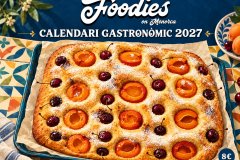
Foodies on Menorca prepares a 2027 gastronomic calendar dedicated to Menorcan baking
Read more27/09/2026Foodies on Menorca
-
 Read more
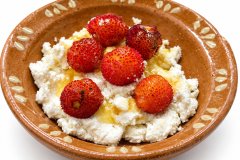
Strawberry tree fruits with honey and fresh whey curd, an old autumn dessert worth reviving
Read more23/09/2026Foodies on Menorca
-
 Read more
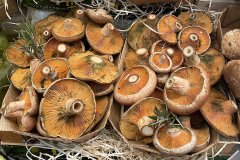
Menorca’s Autumn: Mushrooms, Quinces and Comforting Spoon Dishes
Read more18/09/2026Foodies on Menorca
- Publicitat

-
Publicitat



Sitemap
Cookies policy
Cookie settings
Legal notice
Privacy policy
 © Copyright 2018 - 2026