
Jaume Moll Florit : “The reality of farming is working from dawn to dusk and making constant sacrifices”
 Foodies on Menorca
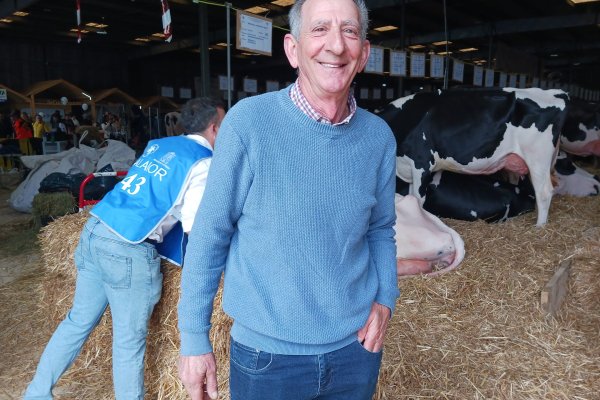
?CM./Alaior - Jaume Moll Florit (Ciutadella, 1960) has been president of the Balearic Friesian Association since 2022, an organisation currently representing 112 livestock farmers across the Balearic Islands. Having devoted his entire life to agriculture and spent more than three decades managing the Son Bou Vell farm, he is regarded as one of the most experienced and respected voices in Menorca’s agricultural sector. Although now retired, he remains closely linked to farming activity, which is currently being continued by his son.
This year’s Agricultural Fair showed a slight increase in Friesian cattle numbers after several years of decline. Nevertheless, Moll warns that the sector’s structural challenges remain firmly in place.
“The main problem is that all costs continue to rise,” he explains. “Higher oil prices directly affect maritime transport, animal feed and virtually every raw material we need. Ultimately, this has a serious impact on livestock farming.”
The president of the Balearic Friesian Association considers the gradual decline in the number of dairy farms in Menorca particularly worrying, even if cattle numbers occasionally increase. “When farms keep disappearing, it is clear that the sector is not moving in the right direction. Every year there are fewer farms, and this is becoming a constant trend.”
According to Moll, insularity remains one of the biggest obstacles to the competitiveness of Menorca’s agricultural sector. “Everything is much more expensive here than on the mainland. Transport affects us completely: we pay more to import feed, fertilisers and any materials needed for farming, but also when we need to export our products off the island.”
He regrets that this dependence on maritime transport places Menorcan farmers and livestock breeders at a clear disadvantage compared with producers in other regions. “Freight costs are suffocating us. We cannot compete on equal terms because our structural costs are far higher.”
Adding to these difficulties is the recent decision by Quesería Menorquina to reduce by 6% the price paid for curd produced by local dairy farms. According to Moll, this measure will have direct consequences for many farms.
“There are farms mainly dedicated to producing curd, and this reduction represents a very significant loss of income,” he says. “Expenses will remain the same, while profits will decrease even further.”
Regarding milk prices, Moll insists that the issue is both structural and longstanding. Despite temporary improvements resulting from the Provilac Plan, Menorca still receives lower prices per litre of milk than the national average.
“Production costs here are much higher, yet farmers are often paid less than on the mainland and even less than in Mallorca. It is a recurring situation that is extremely difficult to overcome.”
Despite the difficulties, the president of the Balearic Friesian Association highlights the importance of continuing to invest in technical and genetic improvements. In this regard, he views public subsidies for Friesian semen very positively.
“This allows farmers to access better genetics and work with more efficient and longer-living animals,” he explains. “One of Menorca’s strengths is precisely the longevity of our cows, which here live almost twice as long. This reduces replacement costs and helps maintain profitability.”
Moll also calls for a major revision of the Special Regime for the Balearic Islands (REB) to compensate for the additional costs associated with insularity. “We always say that while the mainland has highways and large infrastructures, we have the sea. The problem is that this ‘highway’ costs us an enormous amount of money.”
In his opinion, eliminating or substantially reducing transport costs would be decisive in ensuring the sector’s viability. “If we could compete under equal conditions, many of the current aid programmes would probably no longer be necessary because farms would become profitable on their own.”
Despite the positive atmosphere experienced during the Agricultural Fair, Moll reminds people that the daily reality of farming is far tougher than many outsiders realise. “The passion for this work is real. We saw many young people eager to continue, but the big question is whether they will truly be able to make a living from it.”
For the president of the Balearic Friesian Association, the future of generational renewal will depend directly on the economic viability of farms. “If the sector is not viable, there comes a point where passion is no longer enough. It would be very sad if young people could not dedicate themselves to what they truly love.”
He also calls for greater social awareness regarding the demands of agricultural work. “The Fair is a celebration, but the next day reality returns: cold, wind, rain, constant difficulties and extremely long working days. The reality of farming is working from dawn to dusk and making constant sacrifices, often without even a single free day.”
Finally, Moll believes that tradition and innovation must progress together to secure the future of Menorca’s livestock sector. “We cannot stand still. We must preserve our roots while also adapting and modernising in order to remain competitive. The most important thing is ensuring that people can choose to become farmers with the guarantee of earning a dignified living from their work.”


Latest posts
-
 Read more
La Bodega del Jazzbah, signature tapas with a Mediterranean soul
Read more24/09/2026Foodies on Menorca
-
 Read more
Foodies on Menorca recognises the work of restaurants, hotels and producers
Read more20/09/2026Foodies on Menorca
-
 Read more
Foodies on Menorca Vintage revives the spirit of the 1950s to celebrate Menorcan gastronomy
Read more09/09/2026Foodies on Menorca
-
 Read more
White shrimp gain ground in Menorca’s catches as red shrimp become scarcer
Read more28/08/2026Foodies on Menorca
- Publicitat

-
Publicitat



Sitemap
Cookies policy
Cookie settings
Legal notice
Privacy policy
 © Copyright 2018 - 2026