
December gastronomic calendar
 Foodies on Menorca

December used to be considered the coldest month of the year, and its name comes from the fact that it was the tenth month of the Roman calendar. It is also the month when the earth sleeps and will not wake up until February; therefore, farm work is not too heavy.

An almost lost custom was that on Saint Lucy’s Day, 13 December, people would sow tabaco de pota (local tobacco). It was also the day when country folk began their own weather-forecasting cycle for the coming year with the “Cuentas de Salomón” (“Solomon’s tallies”), based on the belief that the 12 days from 13 December to the 25th, Christmas Day, represent the twelve months of the year, and that the weather on each of those days will be the weather that predominates in the corresponding month. This means that the weather on the 14th will correspond to January, that on the 15th to February, and so on, up to Christmas Day, which will give the weather for December of the following year.

As for the harvest, we have potatoes, turnips, cauliflowers, oranges, tangerines, clementines and olives, as well as the first artichokes. It is also the time of porquejades (traditional pig slaughter in Menorca) and of fattening those animals that will be used for Christmas and New Year meals, such as turkeys, young turkeys, chickens, capons and hens, as well as lambs and suckling pigs.

With regard to cooking and gastronomy, it is still mushroom season and time to prepare rice dishes in which they will play the leading role, such as rice with llomillo (this is what we call pork tenderloin in Menorca), esclata-sangs (saffron milk caps) and cames seques (chanterelles), to which some early artichokes and green beans will always be a good addition. It is also small game season, which means we can prepare rice dishes with mushrooms and thrushes and, from 18 December onwards, besides rice, we can cook dishes in which partridge is the main ingredient, as the hunting season for partridge with male decoy begins. Then we have preparations such as partridge with cabbage, Menorcan-style partridge, partridge in salmis… and so many other hunters’ dishes, those recipes of the cobbler–shoemakers who always had cages at home with their perdigots (male partridges), the best songsters, and more than one of them was given the name “Carusso”.

As we have seen, it is harvest time for potatoes, turnips, cabbages and cauliflowers, and with them we prepare the first legume dishes, accompanied by pork from the slaughter and cured sausages that give that very distinctive flavour to chickpeas, beans, lentils and guixons (black-eyed peas), which we can also cook in the pot with pieces of pumpkin.

December is the time for meat stews and broths in which pilota (a traditional meatball) and “xenc” will never be missing. Xenc is an anglicism that comes from “shank”, and in Menorca we use it to refer to that cut of beef running from the elbow to the knee, very gelatinous, unctuous and tender, which in Spanish is called morcillo. In the past it was used to make caldo de xenc, a broth given to sick and convalescent people as a restorative.

It is the time for spoon dishes and also for hearty fork breakfasts, for sauces and stews, for panaderas (oven-baked meat and vegetable trays) with the meat and produce of the land. For cooking around the table and by the fire.

As for seafood cookery, it is the season for rock red mullet, which we grill and serve with a sauce made from their livers, or we can opt for old traditional recipes such as vermicelli with red mullet or red mullet in a pine nut sauce. There is also a very tasty surf-and-turf pairing: red mullet with esclata-sangs (saffron milk caps) and sobrasada sausage.

For desserts, it is the season for pomegranates with muscatel wine and oranges with honey and cinnamon. Time to eat the last madroños (strawberry tree berries) and, in the kitchen, to make greixeres of monyaco (sweet potato), baked monyacoswith milk and sugar, puddings and greixeres of pumpkin, and to start preparing all the pastries, cakes and sweets for the Christmas and New Year festivities.


Latest posts
-
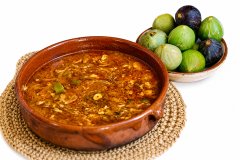 Read more
-
 Read more
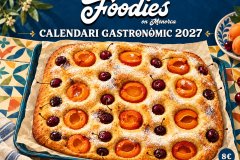
Foodies on Menorca prepares a 2027 gastronomic calendar dedicated to Menorcan baking
Read more27/09/2026Foodies on Menorca
-
 Read more
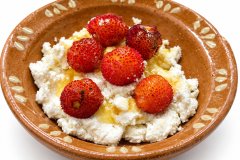
Strawberry tree fruits with honey and fresh whey curd, an old autumn dessert worth reviving
Read more23/09/2026Foodies on Menorca
-
 Read more
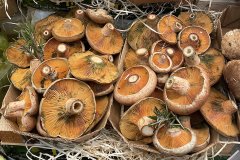
Menorca’s Autumn: Mushrooms, Quinces and Comforting Spoon Dishes
Read more18/09/2026Foodies on Menorca
- Publicitat

-
Publicitat



Sitemap
Cookies policy
Cookie settings
Legal notice
Privacy policy
 © Copyright 2018 - 2026