
How olive oil was traditionally stored
 Foodies on Menorca
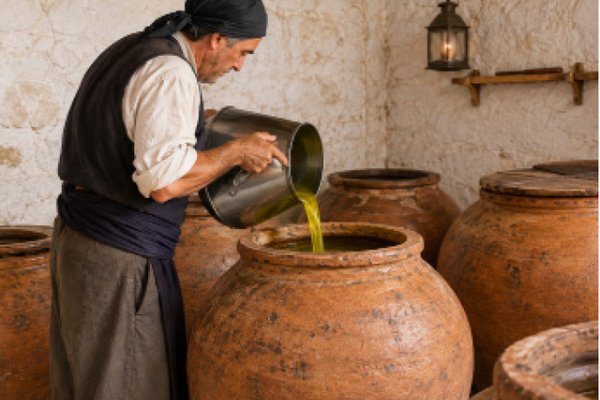
Bep Al·lès/Ciutadella - Olive oil has always played an important role in Menorcan cuisine and gastronomy, almost as important as animal fat and butter. It is used not only in the preparation of savoury dishes but also extensively in traditional baking and pastry-making, including fish-filled formatjades, savoury flatbreads topped with salted sardines (coques amb pinxes), robiols and cocarrois, among other specialities.
In September, we explored how olive oil was traditionally produced, but once it had been made, it needed to be stored and preserved. Virgin olive oil, or oli bo (good oil), as the Menorcans of earlier generations called it, was kept in large earthenware jars known as alfàbies, with a capacity of 200 pounds, equivalent to approximately 80 litres. The oil was left to settle for a month to allow it to clarify before being consumed. Smaller earthenware jars were also kept in kitchens for everyday supplies.
When the oil needed to be preserved for several years in the large 200-pound jars, a rather unusual method was used. Sea sponges were collected, boiled, washed several times and rinsed with vinegar. They were then tied with a cord and suspended inside the jars so that the sponge hung approximately halfway down the container, submerged in the oil. According to this traditional method, the sponges attracted the watery particles believed to form during the fermentation of the oil, allowing it to be preserved for at least three or four years.
It is known that olive trees were grafted onto wild olive trees in Menorca. In fact, Diodorus claimed that the Carthaginians were already practising this technique a thousand years before Christ and that, by the Christian era, many wild olive trees had been grafted with cultivated varieties. These grafted trees produced fruit earlier than olive trees grown from seeds or cuttings, which is why wild olive saplings were traditionally cultivated in nurseries.
Oil was also produced from wild olives, although in much smaller quantities than conventional olive oil. According to some experts, this oil could offer superior quality.


Latest posts
-
 Read more
-
 Read more
Traditional Offal Fry (Freixura or Freixurat), a Culinary Heritage Looking to the Future
Read more22/11/2026Foodies on Menorca
-
 Read more
-
 Read more
Pig slaughtering, a tradition that fed Menorcan families throughout the winter
Read more06/11/2026Foodies on Menorca
- Publicitat

-
Publicitat



Sitemap
Cookies policy
Cookie settings
Legal notice
Privacy policy
 © Copyright 2018 - 2026