
Maria Tudurí, farmer at Es Capell de Ferro: “15 years ago I decided to take on my own farm, Es Capell de Ferro, and put into practice everything I had planned while I was at Capifort”
 Foodies on Menorca
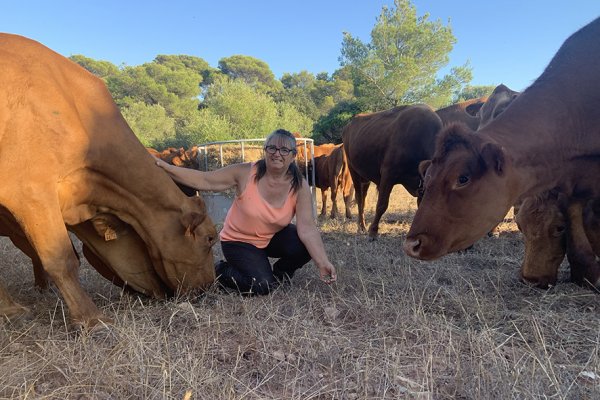
Itziar Lecea/Alaior - Maria Tudurí Sintes (Alaior, 1967) began living in and getting to know the Menorcan countryside when she married and moved to the Capifort farm. It was there that she realised how passionate she was about the sector, that she genuinely enjoyed the work and that it had become a true vocation.
Her family has now been running Capifort for thirty-nine years, and fifteen years ago Tudurí decided to branch out from the joint project —although she remains involved in it— and rent her own farm, Es Capell de Ferro. A place where she could put into practice her ideas and convictions, centred on self-sufficiency, ecology and caring for the land. In this issue of Nua, we wanted to speak to her so that she could tell us more about her experience running her own farm.
How did you end up becoming the farmer at Es Capell de Ferro?
I lived in Alaior, I was born in town, but I moved to the countryside when I married my husband. And it was a job, a whole world, that fascinated me and drew me in from the very beginning. We worked together, with Friesian cows, in the dairy industry. Then, about fifteen years ago, when one of my two sons decided that he wanted to stay and work in farming —after studying at La Granja—, I realised that the time had come to begin my own individual adventure. Without ever completely stepping away from the family project, Capifort.
The truth is that it was a relatively easy decision because I was very clear about what I wanted. Even though the people around me saw it as something impossible. It was not the usual thing to do. To leave the family farm and go off to run another farm on your own. But with the support of my husband and my children, I decided to try.
Now it is not only going well, it has become the project of my life.
What can you tell us about Es Capell de Ferro? What does your project involve?
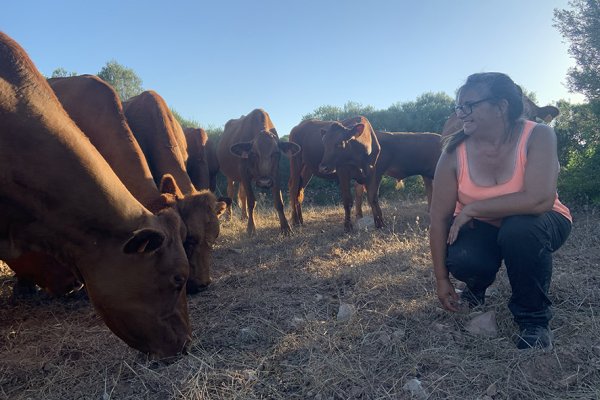
With everything I had learnt from working in the countryside, I decided that at Es Capell de Ferro I would focus on native animal breeds, on native livestock farming, while at the same time trying to supply myself and become self-sufficient. Everything is based on an ecological conviction.
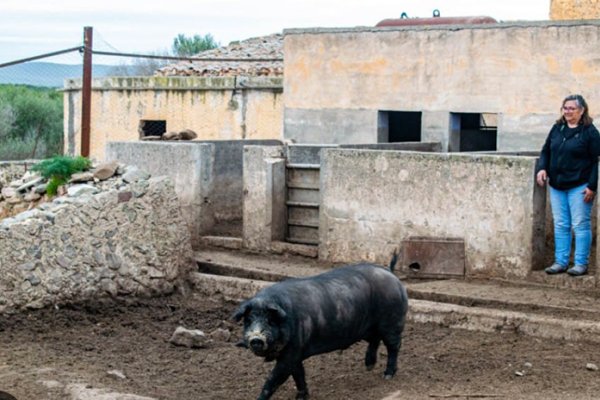
At present I have Menorcan cattle —18 cows, 4 heifers and 1 bull—; black pigs —more than twenty— and, although I tried keeping Menorcan hens, it did not work out, so I currently have around thirty laying hens. The cows are not for milking; instead, I prepare batches of meat. From the black pigs I make cured meats: carn-i-xulla, sobrassada, white botifarró, longanissa... And from the hens, eggs. As I said, everything is organic. I grow everything I feed the animals: hay bales, grass bales, grain, oats, barley and enclova. It is all self-sufficient, except for the hens’ feed, which I buy organic because I have not yet managed to produce it myself.
In addition, grazing on the farm is controlled, and I manage it using an electric fence, with the intention that the animals graze a different section each day, fertilise the land and rotate around the farm. This means that the soil on my farm always has nutrients.
And do you work alone on the farm?
Yes, I work completely on my own. The farm covers around 95 hectares in total. Half of it is scrubland, and I use the other half for growing crops and grazing. I also use half a hectare as a vegetable garden, where I grow seasonal vegetables. As I said, the produce from my farm is organic and officially certified as such.
Everything I produce for sale goes directly to the customer. In other words, I sell directly. That way I make sure I receive a fair price. Two days a week I prepare baskets with everything the customer has ordered and deliver them to their homes. I only do this in the Maó area, and in Es Castell and Sant Lluís if there is enough demand. I simply do not have time to do more.
As for the vegetable garden specifically, when there is an abundance of produce, or when part of it is not as visually attractive, I use it to make jams, preserves, sofritos... and I sell those too.
How would you define the role of women in farming?
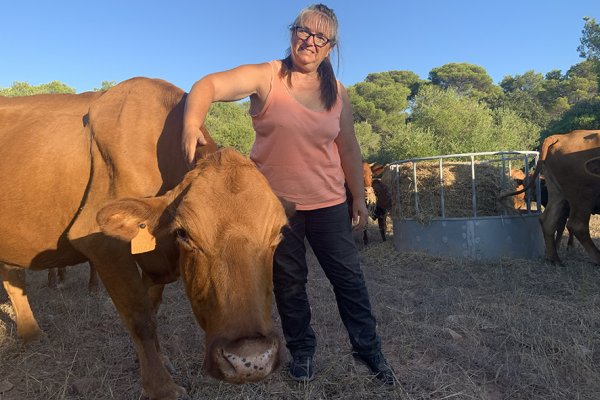
It is fundamental in every respect. There are always things to do and tasks to share out. And in many respects, having a woman involved in running the farm and household is essential. At Capifort, my husband and my son do the farm work, but the paperwork and bureaucracy are my responsibility. Whenever I can, I give them a helping hand.
At Es Capell de Ferro, I take care of almost everything myself, but whenever I need an extra pair of hands, both my husband and my son come to help. We help one another. It is all one family project. If I did not have the support of my husband and my family, I probably would not be able to keep going.
Do you have any future projects for Es Capell de Ferro?
I think I have stability now, and when you achieve that, you should not change too much.
In farming you depend greatly on the climate, but now I have achieved a balance in many areas, and I need to maintain it. Focusing on more things would already be too much. I think I have reached the optimum point, what I wanted when I started this project.
We have had years that were harder than others because we were very tight when it came to having enough feed for the animals, but we managed to balance things and get through it. Sometimes it is not easy. Especially for me, because I want to be self-sufficient. That is why I try not to have too much livestock and to keep something in reserve, something extra. Just in case the rain comes later or there is less of it, as has happened in recent times.


Latest posts
-
 Read more
Sita Muñoz, the public face of Ànima: “Ànima is an expression of our lives. It is about paying attention to beauty, aesthetics, silence, a corner, to what you look at.
Read more15/11/2026Foodies on Menorca
-
 Read more
Francesc Caules, manager of Pins 46, Foodies on Menorca Gastronomy Awards winner in the Best Menu of the Day category: “We make a simple menu, with local produce and no extravagances”
Read more25/10/2026Foodies on Menorca
-
 Read more
Clara Salord, from Binitord Winery, Winner of the Foodies on Menorca Gastronomy Award for Best Wine: “Quality Lies in the Small Details”
Read more20/10/2026Foodies on Menorca
-
 Read more
Lluís Febrer: “We make pastries for everyone; they just happen to be suitable for people with coeliac disease too”
Read more14/10/2026Foodies on Menorca
- Publicitat

-
Publicitat



Sitemap
Cookies policy
Cookie settings
Legal notice
Privacy policy
 © Copyright 2018 - 2026